 Avalanche
Avalanche staking lets you delegate AVAX without running a node
Avalanche staking through native delegation lets you commit AVAX to an existing validator without operating a node. On Mainnet, each delegation requires at least 25 AVAX and lasts between two weeks and one year. Your stake sits on the P-Chain, which records the validator, amount, and end time. The selected validator's performance determines reward eligibility, and its delegation fee reduces any earned reward. The AVAX remains locked for the chosen term; any longer vesting lock still restricts transfers afterward.
Contents
Key takeaway: A validator's current staking window limits a native delegation, even when that validator is configured to renew automatically.
Principal return and missing rewards
At the end of an eligible delegation, the P-Chain returns the staked AVAX and pays the earned reward. A missing reward calls for checking the recorded payout and the validator's eligibility. The wallet's original estimate does not establish that a reward was paid. A P-Chain explorer can distinguish the staked principal from a reward amount, while the wallet's staking history identifies the completed term.
Before the delegation ends, there is no spendable native reward to recover. A dashboard estimate represents a potential payout at maturity.
Failure to qualify for rewards leaves the native staking principal intact because the Primary Network does not slash staked AVAX. A falling AVAX price can still reduce the stake's market value. Lost wallet keys can also prevent access to returned funds.
Which AVAX balance is eligible for native delegation?
Native delegation uses stakeable AVAX on the P-Chain, with additional unlocked AVAX available to pay the staking transaction fee. AVAX on the C-Chain belongs to a separate chain balance. Moving it to the P-Chain involves an export from the C-Chain and an import onto the P-Chain. A wallet interface can coordinate both operations, although an incomplete transfer leaves the AVAX being transferred unavailable for staking.
A displayed AVAX total can therefore exceed the amount available to delegate. Vesting-locked P-Chain funds can be eligible for staking even when they cannot yet be transferred. Unlocked AVAX is still needed for fees. Keeping AVAX available for C-Chain transaction fees is a separate balance decision from locking it on the P-Chain.
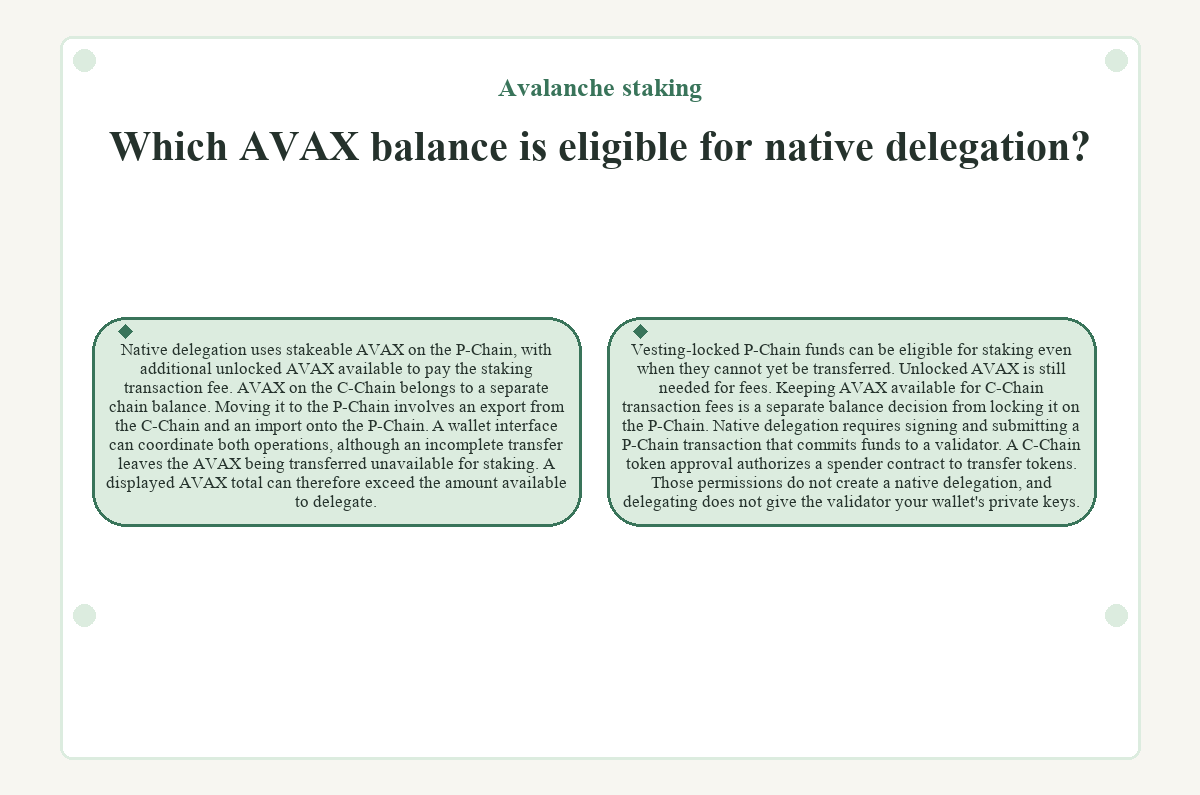
Native delegation requires signing and submitting a P-Chain transaction that commits funds to a validator. A C-Chain token approval authorizes a spender contract to transfer tokens. Those permissions do not create a native delegation, and delegating does not give the validator your wallet's private keys.
Fixed terms and validator capacity
The delegation's end time must fit within the selected validator's staking window, as well as the network's duration limits. Native AVAX delegation on Mainnet has a minimum term of two weeks. Its maximum term is one year. Helicon reduced the Mainnet validator minimum to 48 hours without reducing the delegation minimum. A validator with less than two weeks remaining cannot accept a new delegation. For an auto-renewed validator, the relevant boundary is the end of its current cycle. Future renewal does not extend a delegation across that boundary.
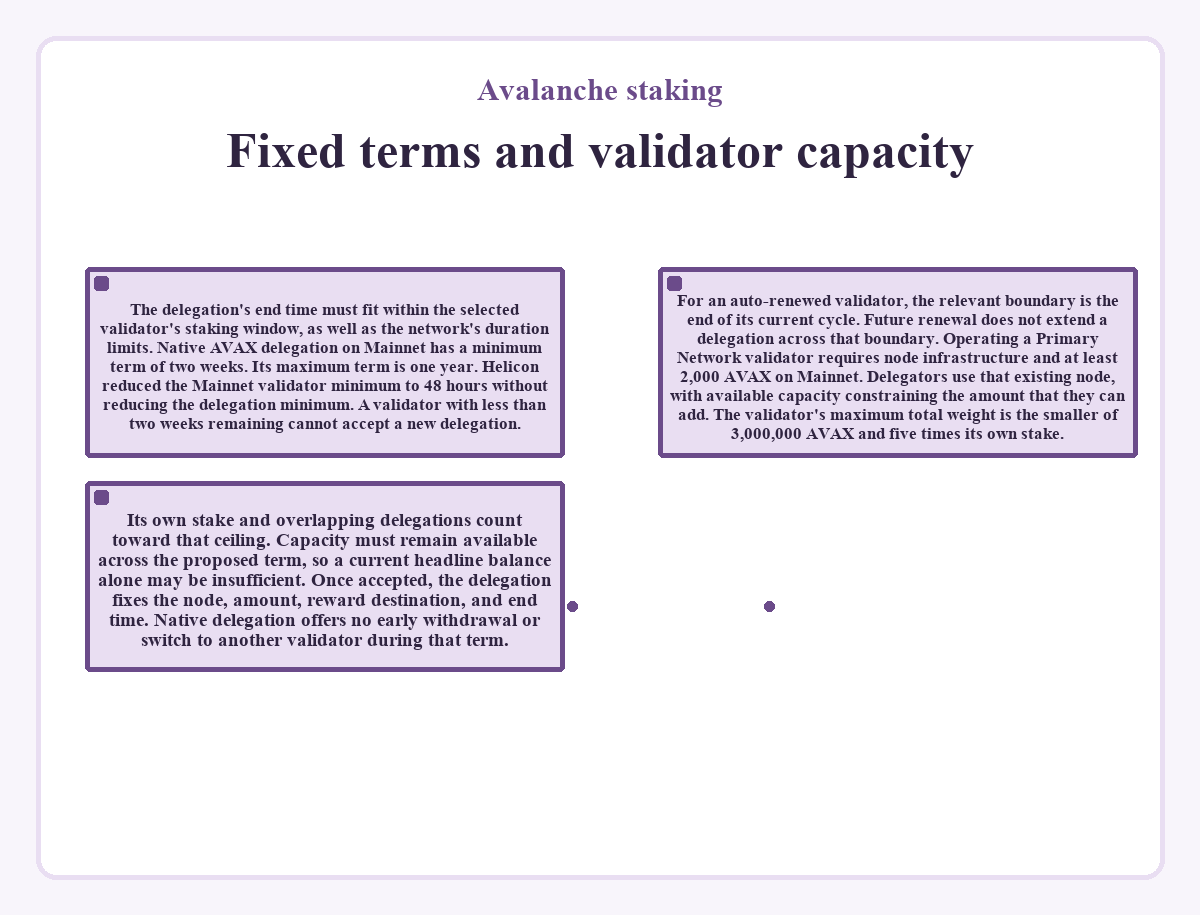
Operating a Primary Network validator requires node infrastructure and at least 2,000 AVAX on Mainnet. Delegators use that existing node, with available capacity constraining the amount that they can add. The validator's maximum total weight is the smaller of 3,000,000 AVAX and five times its own stake. Its own stake and overlapping delegations count toward that ceiling. Capacity must remain available across the proposed term, so a current headline balance alone may be insufficient. Once accepted, the delegation fixes the node, amount, reward destination, and end time. Native delegation offers no early withdrawal or switch to another validator during that term.
How do delegation fees change the reward you receive?
A delegation fee gives the validator a percentage of the gross reward earned by your delegation, reducing the AVAX that reaches you. Mainnet has a minimum validator delegation fee of 2%, and validators can charge more. This percentage applies to the reward, not the staked principal. Network transaction fees and any interface charges have separate payment rules.
Net delegation rewards equal gross rewards minus the validator's share, before accounting for separate transaction or interface charges.
The protocol calculates potential rewards using the stake amount, duration, supply, and applicable issuance parameters at the start of the stake. Longer terms change both the duration and the reward-curve input. Helicon phases a reduction in the lower reward-curve parameter over 90 days after activation. An issuance parameter is separate from a delegation's displayed annualized yield. A quoted yield must also distinguish gross rewards from rewards after the validator's fee.
Validator responsiveness controls eligibility for that potential payout. Mainnet validations beginning at or after September 22, 2026, at 15:00 UTC require at least 90% uptime. Validations that began before that activation retain the 80% threshold. Stake-weighted network assessments determine eligibility; a historical uptime display cannot establish the outcome of an unfinished delegation.
Staking interfaces and signing options
Manual delegation and automatic validator selection both require enough P-Chain AVAX for a valid term and its applicable charges. Manual selection provides control over the node choice; Core Fast Stake assigns the validator. Choose manual delegation when selecting a particular eligible node matters. Automatic selection leaves that choice with the interface, while the resulting native stake still follows the protocol's lockup rules.
| Option | Participation method | Control retained | Main access or reward risk |
|---|---|---|---|
| Core web Delegate | Native P-Chain delegation | Validator selection and wallet signing | Selected validator can fail reward eligibility |
| Core mobile Delegate | Native P-Chain delegation | Validator selection in the mobile wallet | Older dynamic P-Chain addresses may be absent from the display |
| Ledger through Core web | Native delegation with hardware signing | Signing keys remain on the device | A different derivation path can hide intended addresses |
| Platform CLI delegation | Command-line P-Chain delegation | Explicit transaction parameters and configured signing keys | Invalid timing or insufficient capacity prevents acceptance |
| Core Fast Stake | Native delegation with automatic validator assignment | Stake amount and duration | Acceptance still leaves rewards conditional on validator performance |
| BENQI Liquid Staking | C-Chain deposit represented by sAVAX | Transferable receipt token | Contract or signer failures can affect redemption and assets |
Core Fast Stake currently charges an upfront fee equal to 10% of gross estimated delegation rewards. Core's manual delegation does not incur that Fast Stake charge. This interface fee is separate from the validator's reward share and network transaction fees. A Ledger connection changes signing arrangements without changing native delegation requirements.
After choosing a native route, review the node ID, amount, end time, reward address, and charges before signing. A transaction ID alone identifies the submitted transaction. The P-Chain status Committed confirms acceptance; the recorded stake should match the intended settings. Wait for confirmation while the status is Processing. A Dropped result calls for stopping and examining its reason before a corrected submission. Unknown means that the queried node has not seen the transaction. Acceptance confirms participation, while rewards remain conditional until settlement.
Renewal and access through liquid staking
Native delegations finish at their committed end time and require a new delegation to stake again. Core mobile's Restake function can populate a new transaction using a completed stake's parameters. It still requires a fresh review and signature. Helicon's automatic renewal and optional reward compounding apply to validators, while delegations remain fixed term. A validator's automatic renewal does not carry a delegator's stake into its next cycle.
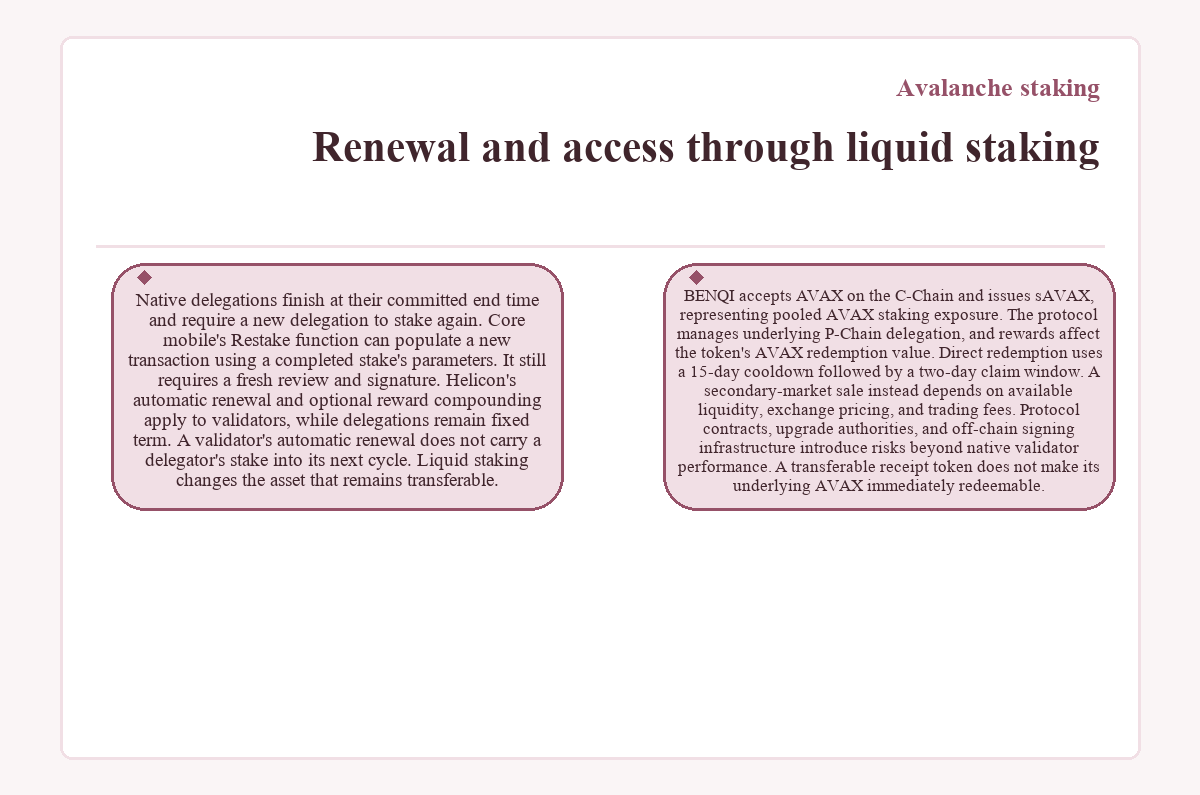
Liquid staking changes the asset that remains transferable. BENQI accepts AVAX on the C-Chain and issues sAVAX, representing pooled AVAX staking exposure. The protocol manages underlying P-Chain delegation, and rewards affect the token's AVAX redemption value. Direct redemption uses a 15-day cooldown followed by a two-day claim window. A secondary-market sale instead depends on available liquidity, exchange pricing, and trading fees. Protocol contracts, upgrade authorities, and off-chain signing infrastructure introduce risks beyond native validator performance. A transferable receipt token does not make its underlying AVAX immediately redeemable.
Avalanche staking: the short answers
Can I divide my stake among several Avalanche validators?
You can create separate native delegations to different validators. Each Mainnet delegation must independently meet the 25 AVAX minimum, fit its validator's staking window, and remain within available capacity. Each transaction also incurs its applicable network fee. An already active delegation cannot be divided or redirected; distributing additional funds requires new delegations using available AVAX.
Where do my principal and rewards go if I choose a custom reward address?
A custom delegation reward address receives any earned reward, while the staking principal returns to the addresses specified by the stake outputs. Choosing another reward destination does not redirect the principal. Both destinations belong to the P-Chain staking transaction. The accepted delegation fixes its reward destination, so an incorrect address cannot be replaced midway through the term.
Why are some older delegations missing from Core mobile?
Older delegations may use dynamic P-Chain addresses that Core mobile does not aggregate. Core web can aggregate previously used addresses and display the associated funds and delegation history. A missing mobile entry therefore does not, by itself, establish that the stake disappeared. The relevant P-Chain transaction and addresses identify the delegation independently of that mobile display.
Which derivation path should I use for Ledger-backed AVAX staking?
The derivation path must match the path that generated the funded addresses. A direct Ledger connection to Core web uses BIP44. Addresses created through the Ledger Live path can instead be accessed through Core extension with that path selected. Different derivation paths can show different addresses without moving any AVAX.
Are C-Chain transaction fees paid to AVAX delegators?
C-Chain transaction fees are burned rather than distributed to native AVAX delegators. Native staking rewards come from AVAX issuance under the protocol's reward calculation. The validator's delegation fee is its share of an earned delegation reward. Increased application transaction fees therefore do not constitute a direct additional payment to your native delegation.
Why can a Fuji delegation use less than 25 AVAX?
Fuji is a test network with different delegation requirements from Mainnet. Its native delegation minimum is 1 test AVAX, and its minimum delegation term is 24 hours. Mainnet requires 25 AVAX and a two-week delegation term. Helicon's shorter validator minimums do not replace either network's delegation minimum. Test AVAX cannot fund a Mainnet delegation.