 Avalanche
Avalanche DEX Approvals and Token Spending Limits
Avalanche C-Chain ERC-20 approvals let a decentralized exchange (DEX) spender contract transfer an authorized token amount from your wallet. Standard allowance-based transfers cannot exceed the remaining allowance or available token balance, subject to token and contract rules. An unlimited approval can expose future deposits of that token into the wallet. Approval alone does not execute a swap.
Limiting continuing access can mean paying for approval transactions when future trades exceed the available cap. The actual spender address and asset type matter, because native AVAX, Wrapped AVAX, and signed permits use different authorization paths.
Key takeaway: Revocation stops spending through the selected allowance once it takes effect on-chain; it cannot reverse earlier token transfers.
Finite caps, maximum allowances, and native payments
An amount-specific approval sets a finite cap tied to the intended token input; a larger finite cap leaves permission for subsequent spending. A maximum-value approval grants a much broader amount, with persistence determined by the token implementation. Existing balances stay in the wallet until a transfer occurs.
| Authorization choice | Transfer permission | Balance and spending authority |
|---|---|---|
| Allowance for the planned trade | Authorizes the intended input amount | Spender can draw only within the remaining cap. |
| Higher finite allowance | Leaves capacity for additional transfers | Unused permission stays with the same spender. |
| Maximum allowance | Very large cap; persistence depends on token rules | Later deposits of the same token can remain accessible. |
| Zero allowance | Disables spending through this ordinary allowance | Owner retains tokens that have not already moved. |
| Token permit where supported | Creates an allowance from a signed message | Named spender gains access after successful on-chain execution. |
| Native AVAX payment | Sends the value attached to a supported payable call | Wallet authorizes the transaction's AVAX value. |
An approval changes transfer permission without depositing tokens into the DEX. The spender receives authority over the permitted token amount, while the wallet retains its signing keys.
How much can an approved DEX contract spend?
For a standard allowance-based transfer, the approved contract can draw no more than the remaining token allowance or the wallet balance, whichever is lower. Its own code also limits which transfers callers can initiate.
Read allowance(owner, spender) on the correct token contract and network to inspect permission for the selected owner and spender. Token symbols do not uniquely identify contracts. A DEX interface may propose a router or another execution contract as the spender. That address must match the component that actually pulls the input tokens.
For ordinary ERC-20 transfers, spending through transferFrom reduces a finite allowance by the transferred amount.
The cap does not renew for each trade. A cap may exceed the current balance; later deposits can become accessible within the unused allowance. Some token implementations leave maximum-value allowances unchanged after spending, so a successful trade need not reduce that permission.
Continuing access after a single swap
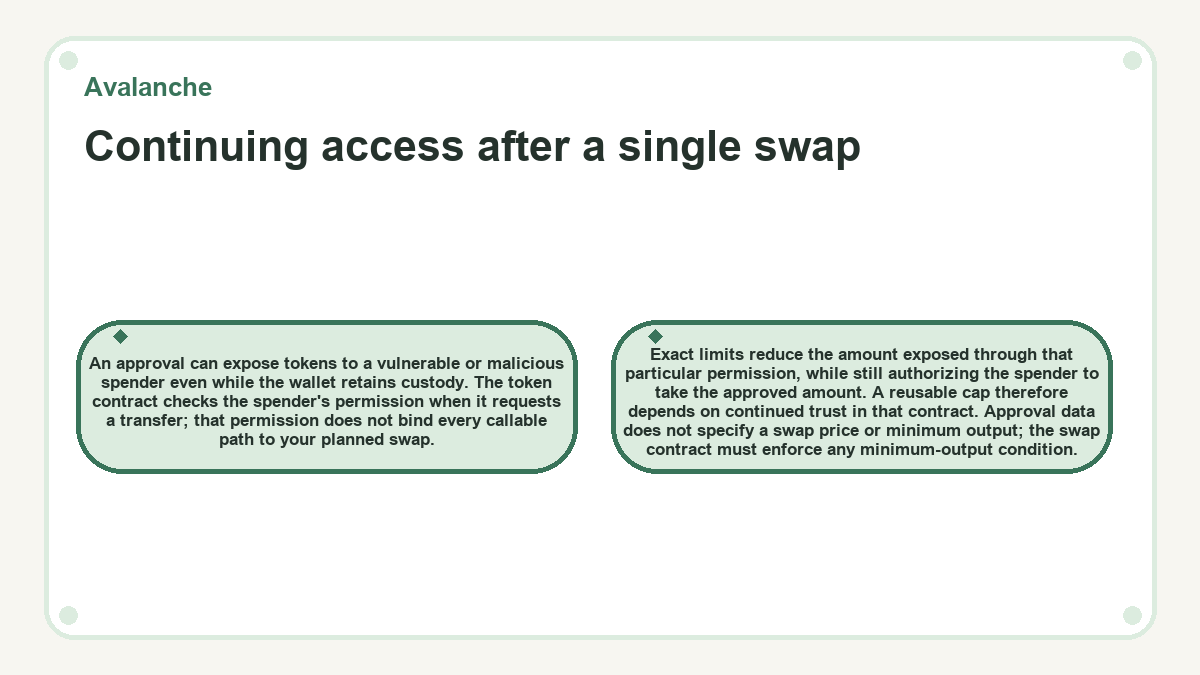
An approval can expose tokens to a vulnerable or malicious spender even while the wallet retains custody. The token contract checks the spender's permission when it requests a transfer; that permission does not bind every callable path to your planned swap. Exact limits reduce the amount exposed through that particular permission, while still authorizing the spender to take the approved amount. A reusable cap therefore depends on continued trust in that contract.
Approval data does not specify a swap price or minimum output; the swap contract must enforce any minimum-output condition.
Approval costs and transaction boundaries
An ordinary approval transaction costs AVAX on the C-Chain because it changes contract state, and the cost depends on charged gas and effective gas price. The approved amount is measured in the token and does not establish the AVAX gas charge. Token implementation details and the state change affect gas use; transaction fee settings constrain the price per gas unit. Under Helicon, active on C-Chain Mainnet since September 22, 2026, charged gas is the greater of gas used and half the gas limit, rounded up. Raising the limit above twice the gas used can therefore increase the fee. Approval fees and any saving from unlimited allowances vary with those inputs.
A reverted swap transaction does not undo an earlier successful, separate approval transaction. Its token-state changes, including allowance consumption during the swap, revert with the failed transaction. A new allowance must take effect before a swap can rely on it, while an already sufficient allowance can remove the need for another approval.
An ordinary C-Chain revocation also requires AVAX gas, even when the allowance is being reduced to zero.
Native AVAX and Wrapped AVAX
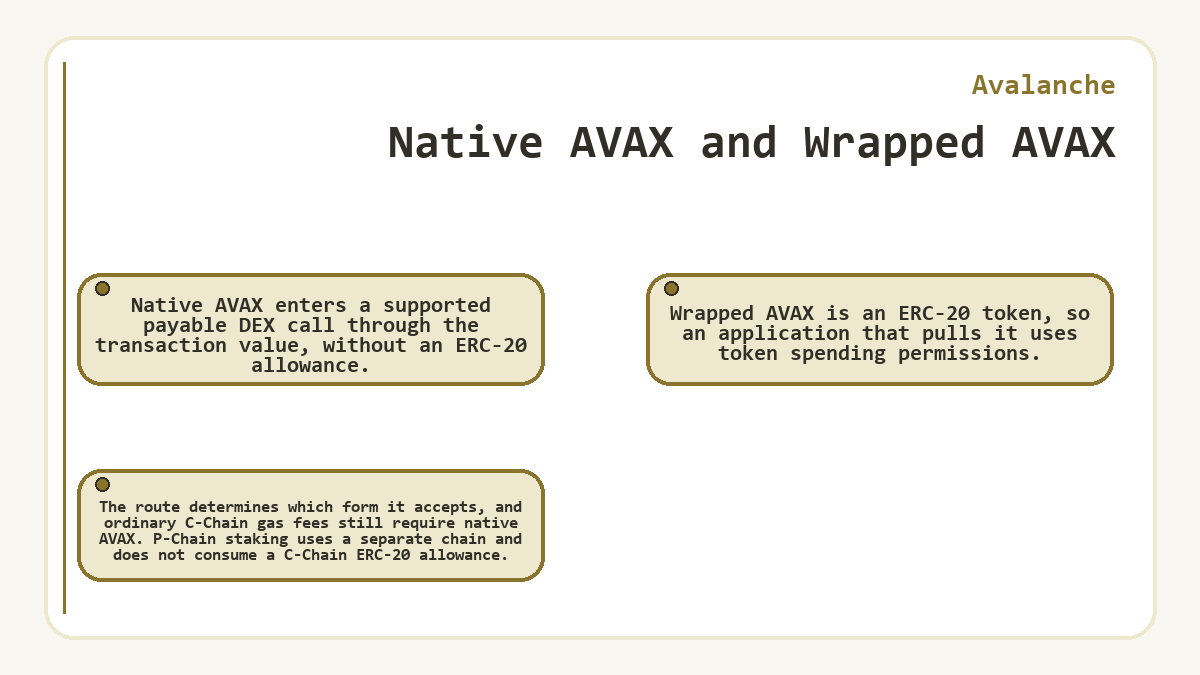
Native AVAX enters a supported payable DEX call through the transaction value, without an ERC-20 allowance. Wrapped AVAX is an ERC-20 token, so an application that pulls it uses token spending permissions. The route determines which form it accepts, and ordinary C-Chain gas fees still require native AVAX. P-Chain staking uses a separate chain and does not consume a C-Chain ERC-20 allowance.
Can a signed permit replace an approval transaction?
A supported token permit can replace the owner's separate approval transaction with a signed message that an application submits on-chain. Under ERC-2612, the message specifies the owner, spender, amount, nonce, and deadline. The token, wallet signing method, and application's transaction path must support the permit format. Signing a permit requires no gas payment. It authorizes an allowance update that takes effect only through successful on-chain execution, which still incurs gas fees.
Signature validity and lasting permission
Submission deadline
The permit deadline limits when a signature can establish a standard ERC-2612 allowance; it does not automatically expire the resulting permission. A standard ERC-2612 permit fails if its deadline has passed or its nonce no longer matches. Token-specific permit variants can use different semantics, so an expiry label needs the meaning defined by that actual implementation.
Unsubmitted signatures
An unused permit signature can remain usable while its deadline and nonce requirements still hold. A plain allowance reset does not necessarily invalidate that signature; its holder can recreate the allowance through valid submission if those requirements remain satisfied.
Revocation, allowance changes, and pending requests
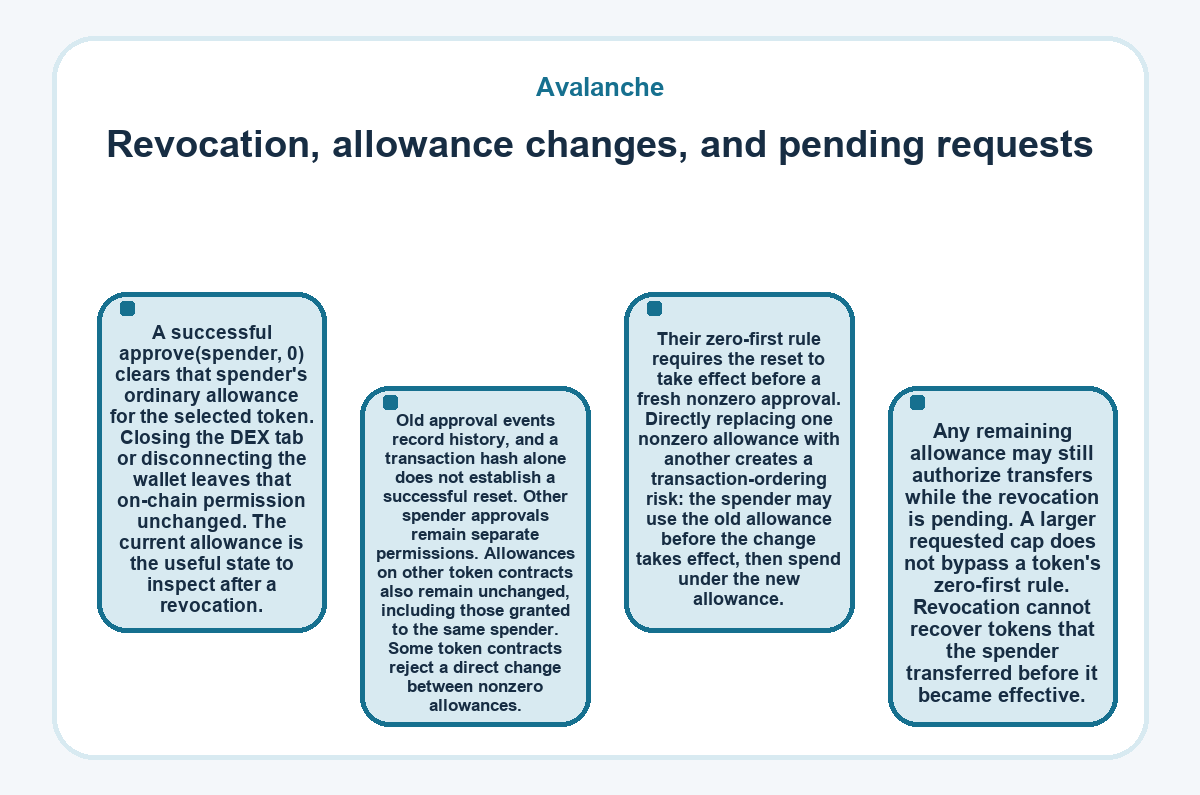
A successful approve(spender, 0) clears that spender's ordinary allowance for the selected token. Closing the DEX tab or disconnecting the wallet leaves that on-chain permission unchanged. The current allowance is the useful state to inspect after a revocation. Old approval events record history, and a transaction hash alone does not establish a successful reset. Other spender approvals remain separate permissions. Allowances on other token contracts also remain unchanged, including those granted to the same spender.
Some token contracts reject a direct change between nonzero allowances. Their zero-first rule requires the reset to take effect before a fresh nonzero approval. Directly replacing one nonzero allowance with another creates a transaction-ordering risk: the spender may use the old allowance before the change takes effect, then spend under the new allowance. Any remaining allowance may still authorize transfers while the revocation is pending. A larger requested cap does not bypass a token's zero-first rule. Revocation cannot recover tokens that the spender transferred before it became effective.
Avalanche FAQs
Will a C-Chain approval also apply on another network?
A C-Chain allowance authorizes spending only in that chain's token contract. An identical wallet address on another network does not carry the permission across. Each network maintains its own contract state. This also means a revocation on a different network does not clear the C-Chain approval, even when both interfaces show the same token symbol.
Why does an approval display an unusually large token amount?
A large displayed approval can represent a large spending cap or an integer amount that needs decimal scaling. Raw allowances use token base units, which must be interpreted with the token's decimal convention. Those units are separate from the question of whether the cap is unlimited. The ERC-20 standard makes the decimals metadata method optional, so no universal decimal setting applies to every token.
Which address should an approval transaction call?
A direct ERC-20 approval transaction calls the token contract, with the spender address supplied as an argument. The transaction recipient and authorized spender therefore have different roles. Sending a token transfer to the DEX does not create the same allowance. The approval data must identify the intended spender and permitted amount; the transaction destination must identify the selected token contract.
Is increasing a spending cap enough to fix a failed swap?
A larger cap only addresses a swap failure caused by insufficient allowance for the actual spender. It does not fix an insufficient token balance, missing AVAX for gas, or token transfer restrictions. Raising the allowance also cannot change the swap's minimum-output condition. Increasing access without identifying the failure can leave a broader permission in place while the original problem remains.
Does a hardware wallet remove the risk of DEX approvals?
A hardware wallet does not remove the authority created by a DEX approval. The device protects the signing key, while a confirmed ERC-20 allowance lets the approved spender use its permitted contract paths without another device confirmation. Review the actual spender and amount in the approval request, since those details define the spending authority being granted.
Can receiving tokens create a new DEX approval?
Receiving a standard ERC-20 transfer does not itself grant a DEX a spending allowance. The transfer changes balances, while an ordinary approval requires authorization from the token owner. Receiving an unsolicited token does not, by itself, authorize spending from a different token contract. Existing allowances can still apply to later deposits of their own token, which is a separate permission already recorded on-chain.
Are my past approvals private after I disconnect the DEX?
Past on-chain approvals remain public after wallet disconnection. Disconnecting changes the application's wallet connection and does not erase blockchain history. Approval events identify the owner and spender addresses, while the token contract exposes allowance state. A site that already knows an address can query public records without an active wallet connection.